



Untangling lupus through multi-omics to advance precision medicine
The international research programme ULTIMA (Untangling Lupus Through Integrative Multi-Omics Approaches), coordinated by Ioannis Parodis at Karolinska Institutet and the Center for Molecular Medicine (CMM), has received a Lupus Research Alliance Global Team Science Award (GTSA), providing USD 3 million in funding over three years.
Systemic lupus erythematosus (SLE) is a highly heterogeneous disease. Patients with apparently similar manifestations can follow very different disease trajectories and respond differently to the same treatment. ULTIMA aims to uncover the molecular mechanisms underlying these differences and translate them into biomarkers that can support more precise patient stratification.
TWO KEY DISEASE TRANSITIONS
Building on the longitudinal SLE cohorts and multi-omics resources established within the 3TR consortium, ULTIMA will focus on two clinically important transitions:
Active disease → Treatment response or refractoriness
Quiescent disease → Flare
The programme will combine longitudinal clinical information with multiple molecular and multi-omics approaches to identify mechanisms and biomarkers associated with these different disease trajectories. Promising findings will then undergo functional and validation studies.
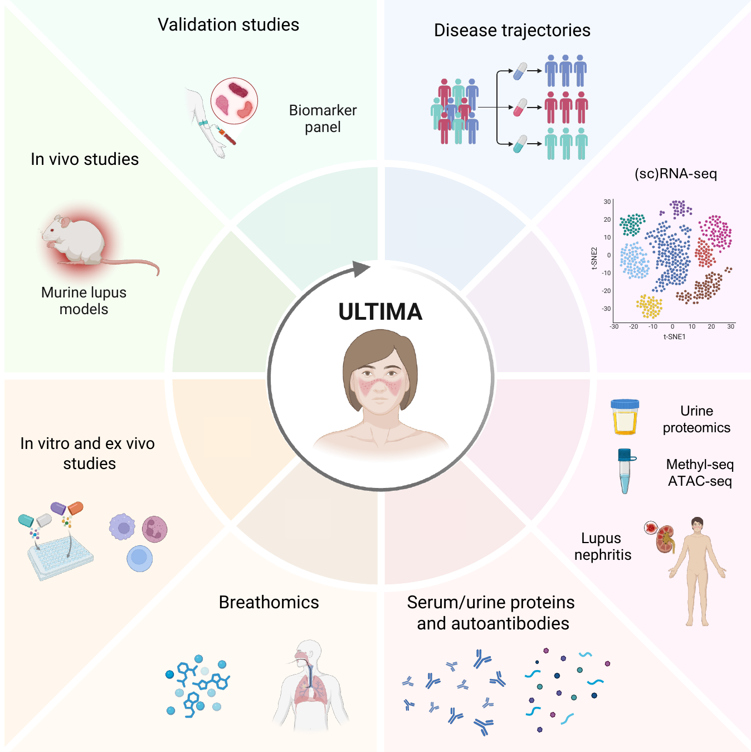
Conceptual overview of ULTIMA: longitudinal disease trajectories are linked to multi-omics profiling, functional studies and biomarker validation, with the goal of developing clinically useful predictive tools.
AN INTERNATIONAL COLLABORATION
ULTIMA brings together five academic research groups from:
- Karolinska Institutet, Sweden
- GENYO and the University of Granada, Spain
- Amsterdam UMC / University of Amsterdam, the Netherlands
- Fondazione IRCCS Ca’ Granda Ospedale Maggiore Policlinico, Milan, Italy
The programme is coordinated by Ioannis Parodis (Karolinska Institutet / CMM), with Marta Alarcón-Riquelme, Ronald van Vollenhoven, Lorenzo Beretta and Guillermo Barturen as co-principal investigators.
Ultimately, ULTIMA seeks to develop clinically actionable biomarkers and predictive models to improve treatment selection, disease monitoring and flare prediction, contributing to the advancement of precision medicine in SLE.
By untangling the complexity of lupus, ULTIMA aims to bring us closer to a future where treatment can be better tailored to each patient.